
Light, Caught Mid-Leap
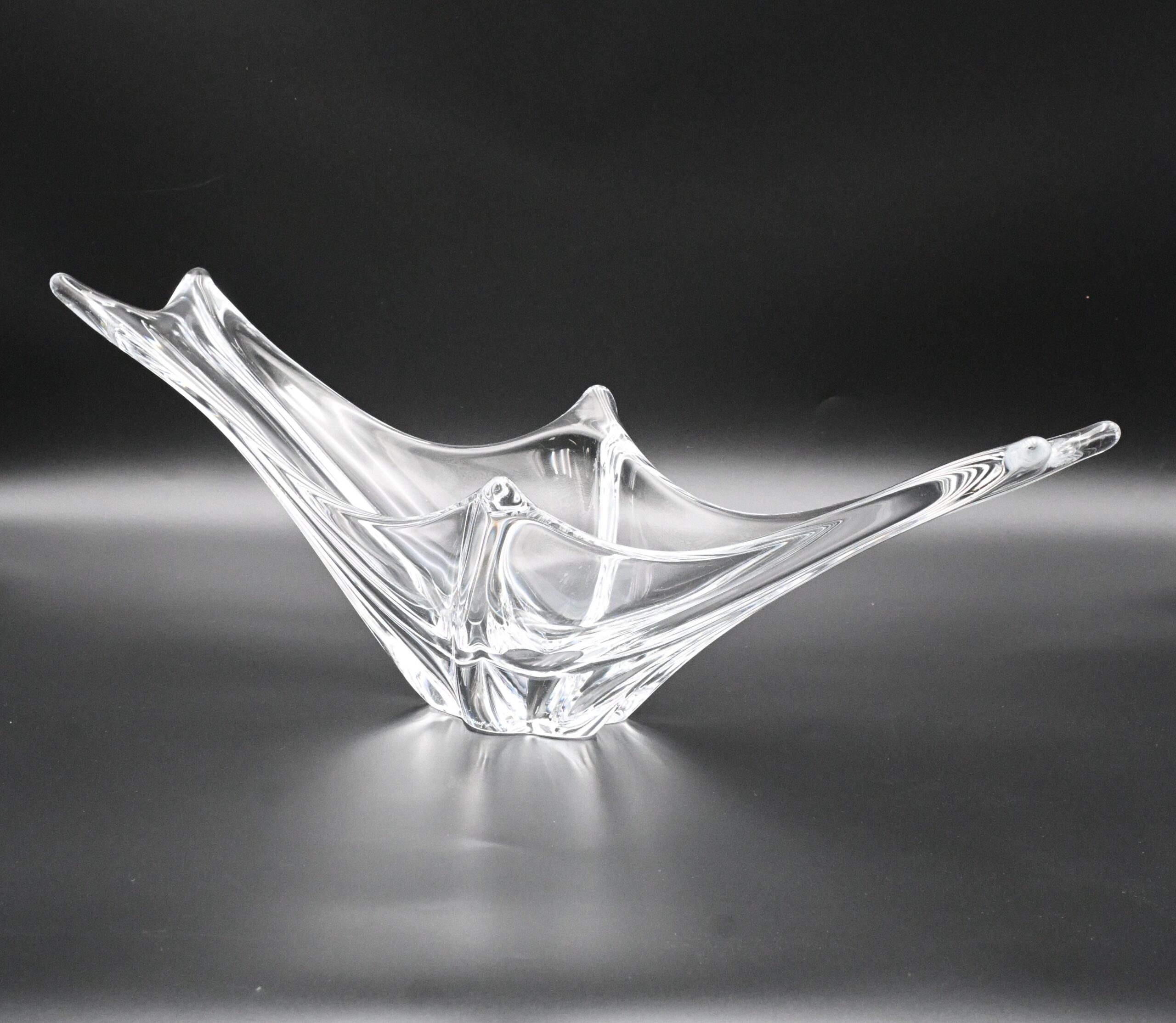
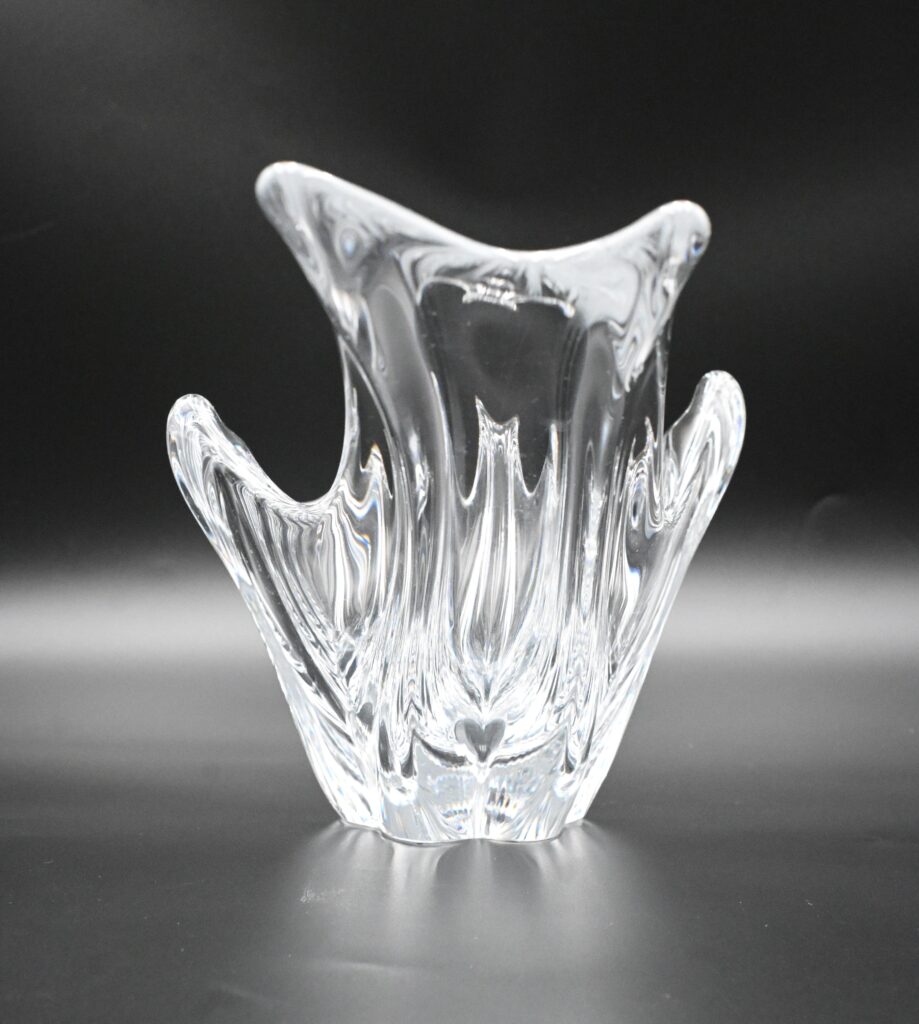
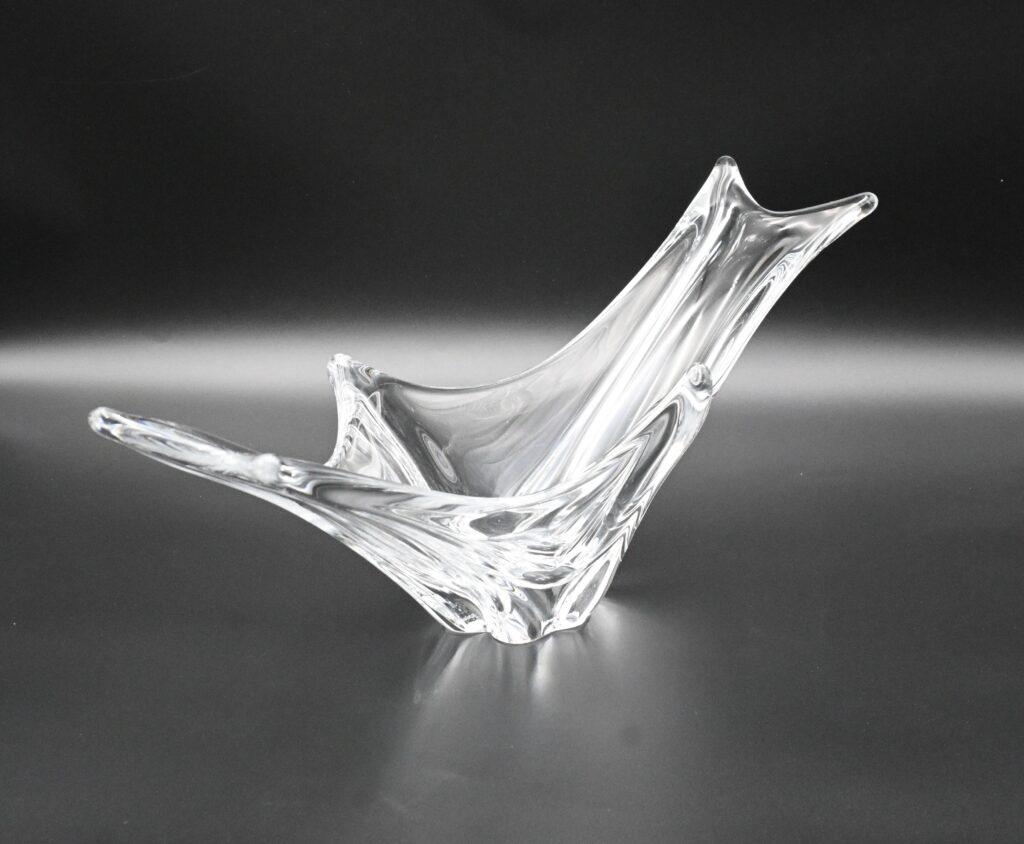
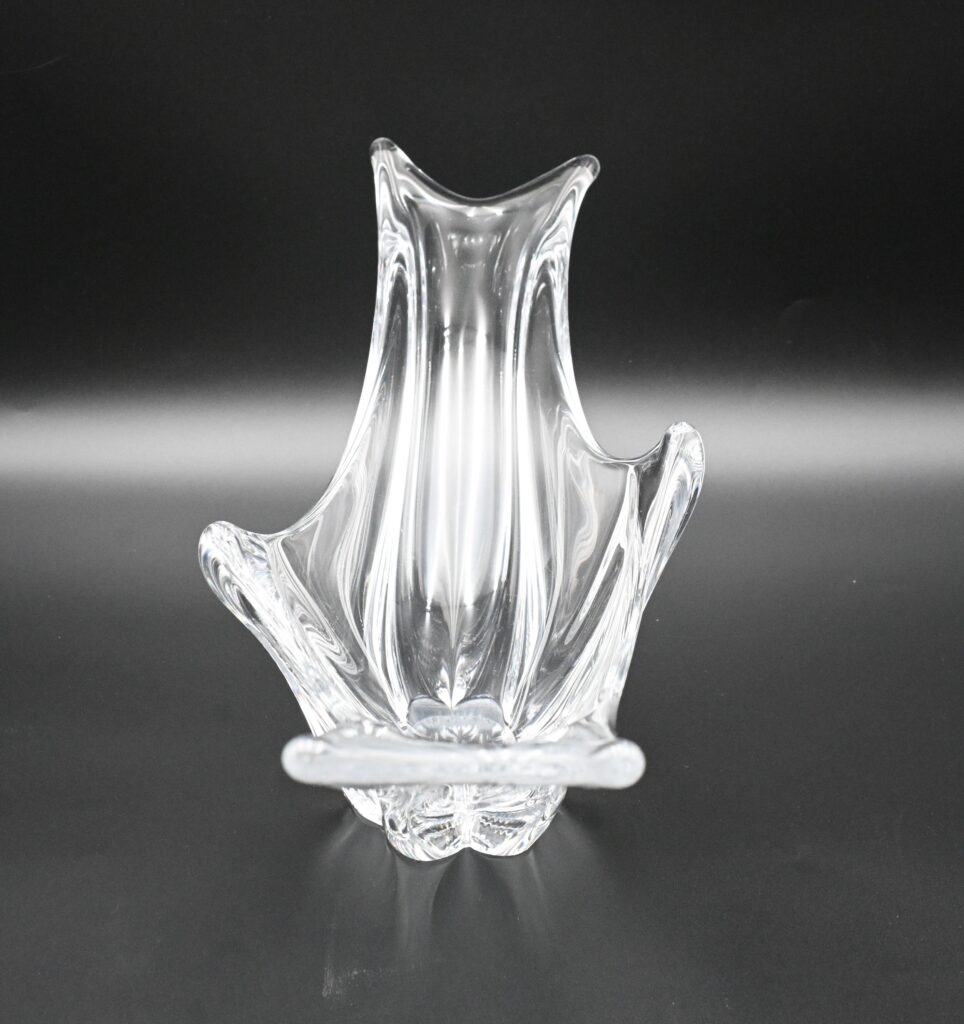
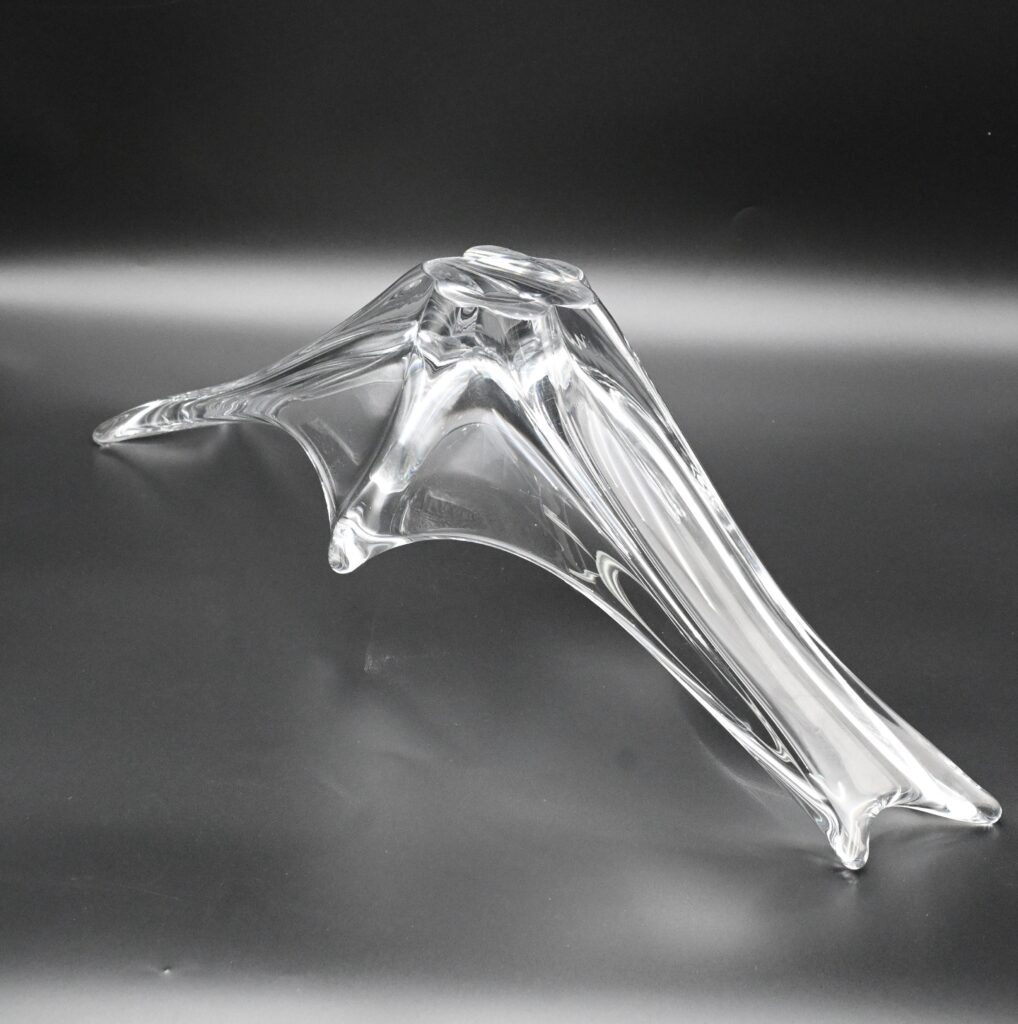
Some objects sit on a table. This one appears to have just landed there. From the side it reads almost as one long gesture: a low, heavy foot gathers the crystal together, and then the glass rises in a long, lifting reach, splits into points at either end, and leaves a hollow in the middle that keeps catching light from every direction. Walk around it and the shape changes. Seen end-on, it becomes a flame, ribbed and narrow, with two tips flaring up from a pinched base.
The base carries a quiet etched script, "Daum France," and that name places the piece within one of the longest and most inventive stories in French glass. Before we turn the vase over again, let us go back to where that name began.
A Notary's Glassworks in Nancy
Daum did not begin with an artist. Jean Daum (1825-1885) had trained and worked as a notary in the Lorraine town of Bitche. After France lost the Franco-Prussian War, the Treaty of Frankfurt of 1871 handed much of Alsace and Lorraine to Germany, and a great many French families moved west to Nancy, the first large city on the French side of the new border. The Daums were among them. Jean took over a struggling glassworks in settlement of a debt, and from 1878 it traded as the Verrerie de Nancy, turning out watch glasses, window glass and tableware.
The change came with his sons. After Jean's death in 1885, Auguste took over the running of the works and Antonin, who had trained as both an engineer and an artist, took charge of artistic direction. Fellow Nancy glassmaker Émile Gallé had drawn admiring crowds at the Paris Exposition Universelle of 1889, and the brothers moved quickly. By 1891 they were enamelling and engraving vases with flowers, fruit and trees. By 1893 they were producing cameo glass that combined acid etching with intaglio carving, and that year they exhibited at the World's Columbian Exposition in Chicago, where the signature "Daum Nancy" earned an international reputation.
Antonin set up an art department that, over roughly twenty years, built a catalogue of close to three thousand models. When the École de Nancy was formally founded in 1901, a regional alliance of the decorative arts, Gallé served as president and Antonin Daum and the furniture maker Louis Majorelle as vice-presidents. Antonin outlived Gallé by decades, which allowed him to carry the firm from Art Nouveau into the cleaner lines of Art Deco.
The Turn Toward Clear Crystal
Daum has always managed to reinvent itself while staying recognizable. Its mid-twentieth-century work moved away from the layered colour of the Art Nouveau years toward thick, colourless crystal shaped into fluid, abstract forms. Dealers' catalogues of that period are full of freeform bowls, vases and centrepieces with points and arms reaching out from a heavy base, as well as amorphic, freehand-formed crystal lamps credited to Michel Daum. Describing a pair of the firm's period candlesticks, one specialist notes that the pieces were blown by hand, their arms joined to the base while still hot and then shaped with tools. That process leaves each piece slightly different from the next.
The house kept looking for new techniques. In 1968 it modernised an older glass-paste method into its own pâte de cristal. Today Nancy's Musée des Beaux-Arts holds more than 900 Daum pieces, a collection the city describes as unmatched anywhere.
The signature changed along the way. Early pieces read "Daum Nancy," often with the double-barred Cross of Lorraine, while collector guides note that the firm's modern crystal is typically engraved "Daum France," the same form this vase carries on its base.
Reading This Piece
The listing describes clear crystal in an asymmetrical, flame-like form, with four irregular points sweeping up around the rim. The photographs show how much drama that creates. Two points stretch out at opposite ends, one long and raised like a wing, the other lower and reaching, while two shorter peaks rise from the middle like crests on a wave. The result never looks quite the same from two angles, which is the whole pleasure of the form.
Below the rim, the body is ribbed and textured, and those ribs are what turn the vase into a flame. They run up from the foot in long, softened channels that bend light into silvery streaks, so the crystal seems to move as you move. The body tapers to a sculpted, pedestal-style foot with lobes that spread the weight and give the rising form a firm footing. The polished finish throughout lets every curve read cleanly, from the thick heart of the base to the fine tips of the points.
Turned over, the piece shows its underside and the etched script signature, "Daum France." The listing names no model, designer or year, and none is offered here. The signature and the crystal are enough to tell the story.
Why Collectors Love Daum Crystal
Some glass is collected for its colour or its rarity. Daum's clear freeform crystal is loved for something simpler: the way it holds light. Set on a dark table or a mantel near a window, a piece like this collects reflections and throws them back across the room. It works well beside mid-century furniture, and it can be just as striking in a pared-back modern room, where one sculptural piece is enough.
There is also the pleasure of the name. A signed Daum piece links its owner to a line that runs from a notary's rescued glassworks, through the École de Nancy and Art Deco, to a house still at work in Nancy today. For many collectors, crystal like this is the most direct way to bring that history home: no ornament, no colour, just the material and the form.
Lot 4031 is the kind of piece that changes with the light all day long, and it is a fine way to own a signed work from one of France's great crystal houses. We invite you to bid on this Daum France freeform vase in the Lionheart Auction sale on Proxibid, on Saturday, November 28, 2026 at 4:00 PM ET.