
Saturday, in Full
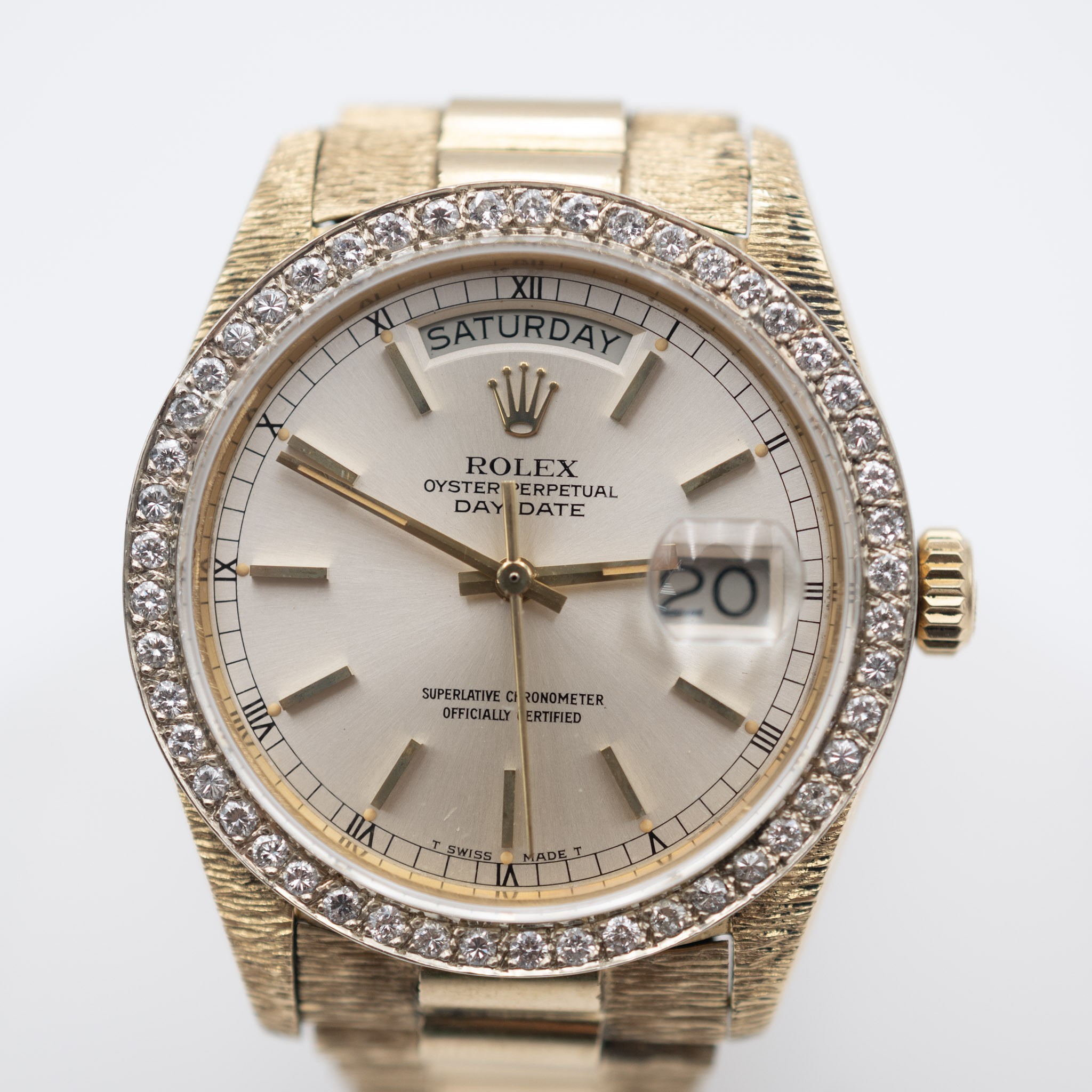
Some watches tell you the time. A few tell you where you are in your life, or at least in your week. Under the twelve o'clock marker of Lot 4016, a window reads SATURDAY in neat capitals, like a page lifted from a desk calendar. At three o'clock, the date window shows 20 beneath its magnifying lens. It is a small piece of information, nearly domestic, and yet it carries one of the most important ideas in twentieth-century watchmaking: a wristwatch could keep track of the week as well as the minute.
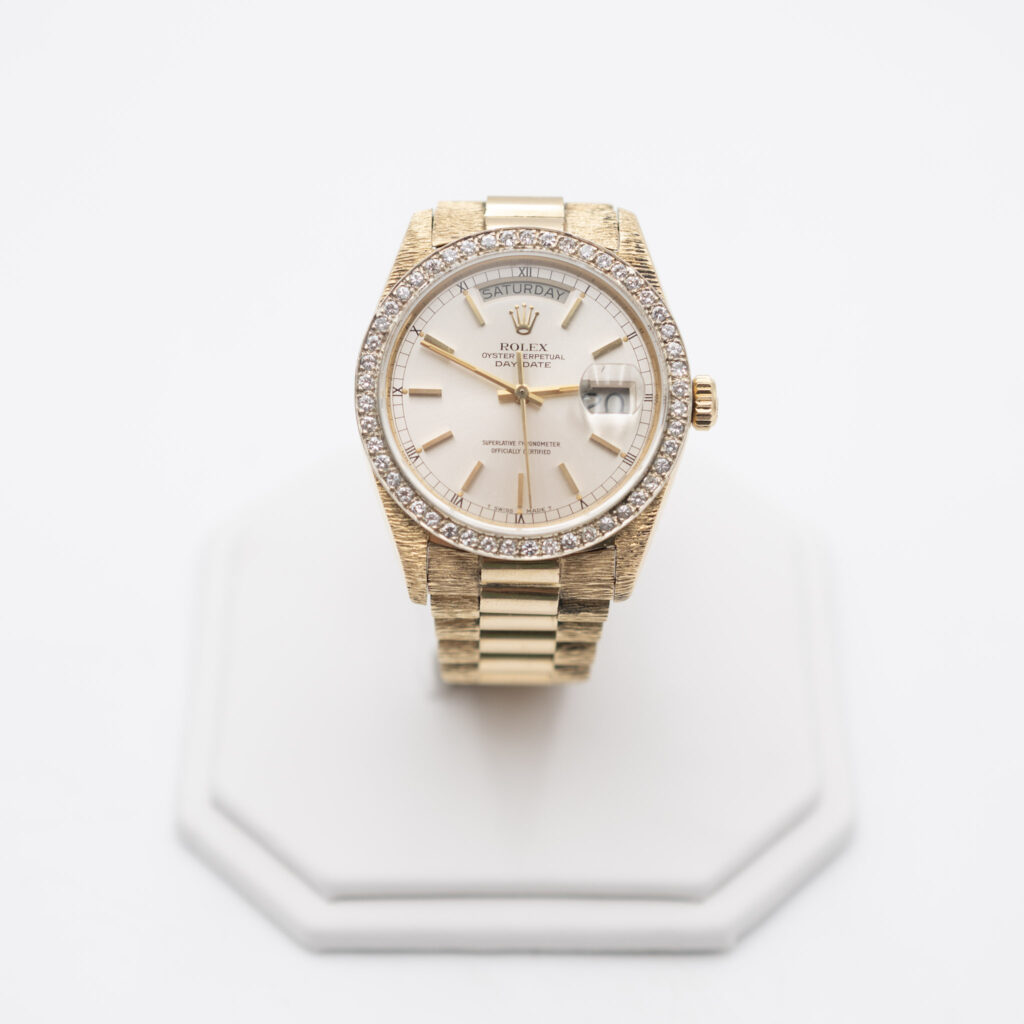
This is a Rolex Oyster Perpetual Day-Date. It is cased in gold with a bark finish that runs across case and bracelet, and its bezel is set with round brilliant-cut diamonds. Collectors simply call it the President, and it deserves a slow, appreciative look.
Basel, 1956: A New Kind of Flagship
Rolex introduced the Day-Date at the Swiss Industries Fair in Basel in 1956. It was the first wristwatch to show both the date and the day of the week, with the day spelled out in full in a window on the dial. From the start Rolex meant it as the flagship of the house.
The first references were built around the firm's patented waterproof Oyster case and a self-winding Perpetual movement. Those two inventions still open the dial text on watches like this one. The Day-Date is also a certified chronometer, which explains the line about a superlative, officially certified chronometer printed on its lower dial. Over the decades the line moved through new movement generations. When the long-running early reference was retired in the late 1970s, sapphire crystals and flatter dials took its place, and much later came larger 40mm and 41mm versions. The watch's basic layout never changed: the day sits at twelve and the date at three.
How a Bracelet Became a Title
The Day-Date arrived with a bracelet made for it alone, three rounded links across its width. Rolex was already calling it the President bracelet by 1957. The name soon grew into a nickname for the whole watch. In 1965 Lyndon B. Johnson became the first American president with a gold Day-Date on his wrist, and Rolex went on to advertise it as the presidents' watch. Later presidents chose the model, and so did figures as different as Warren Buffett and Michael Jordan, which only made the nickname stick more firmly.
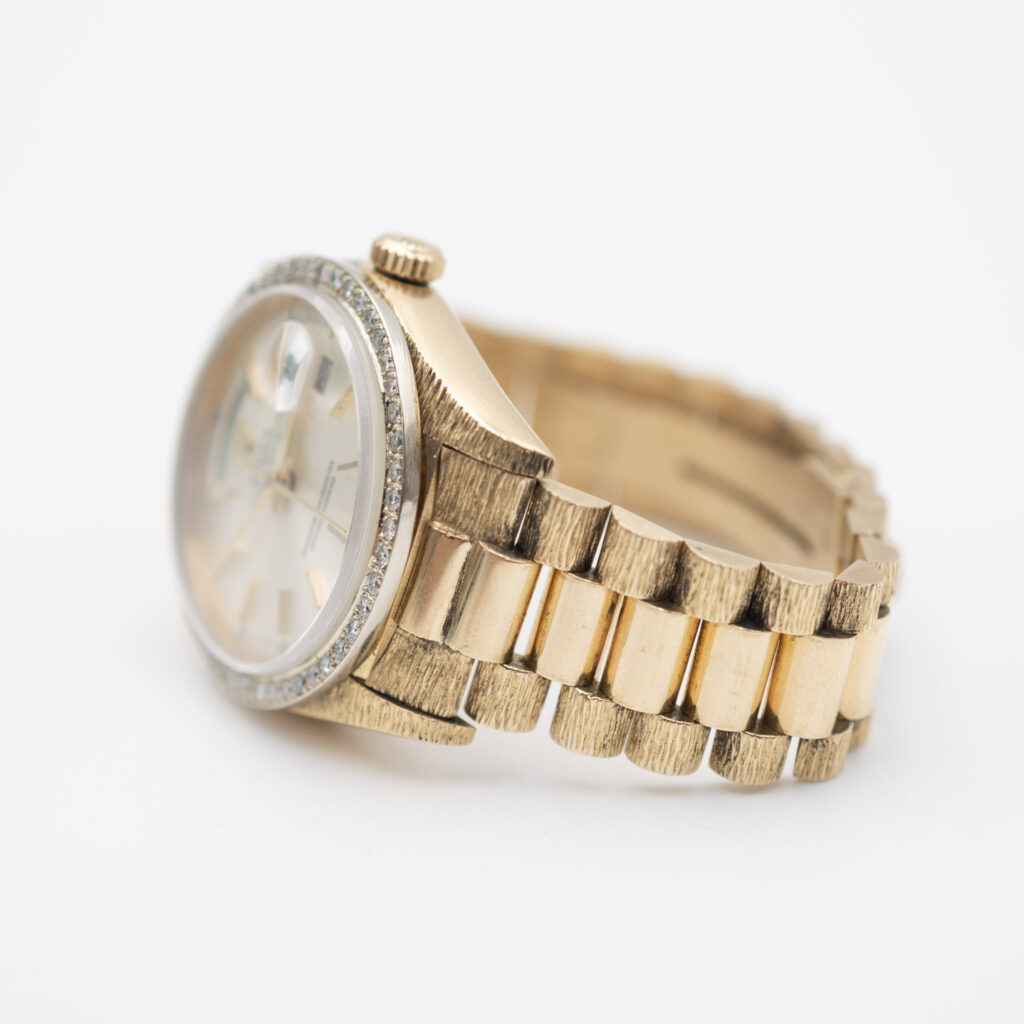
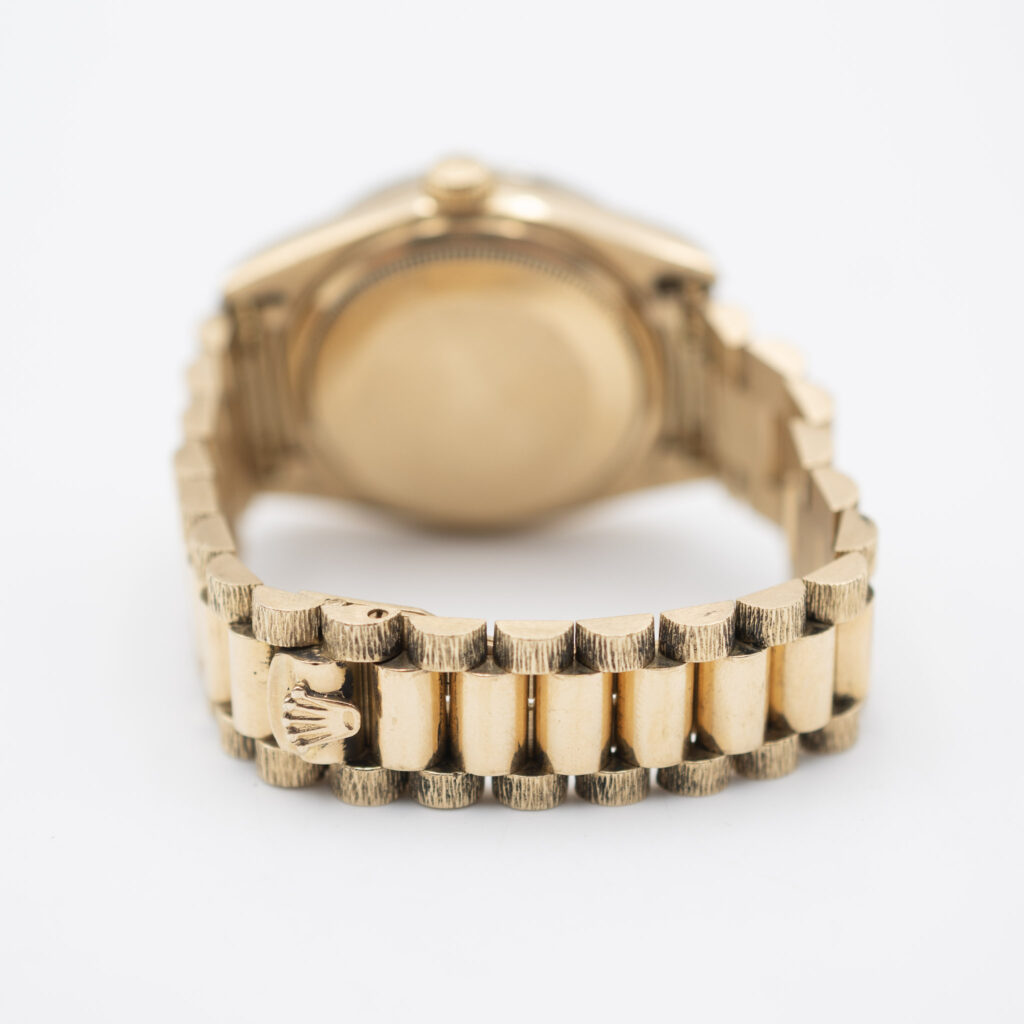
Few bracelets can be recognised so easily from across a room. The half-round profile of the links, the way they ripple as the wrist turns and the folding clasp finished with the Rolex coronet give it an air of quiet authority rather than show.
Gold With the Grain of a Tree
What sets this example apart is its surface. Most people picture a mirror-polished Day-Date, but this case and bracelet carry a bark finish, sometimes called Florentine. The texture is a dense, striated grain that runs like lines in tree bark. The photographs show it best along the lugs and the outer bracelet links, where the gold catches the light in fine, broken lines. Between them, the smooth centre links of the President bracelet glow with a softer light. The contrast gives the whole watch a sculptural quality that changes as it moves.
The earliest Day-Dates had a fluted bezel. This one is framed by a close-set ring of round brilliant-cut diamonds, and their cool white brilliance sets off the warm gold on either side.
The silver dial is classically composed. Applied gold baton markers mark the hours, and Roman numerals circle the outer chapter ring, so the dial feels both crisp and gently traditional. At twelve, the Rolex coronet sits above ROLEX, OYSTER PERPETUAL and DAY-DATE. The chronometer wording sits below centre, and SWISS MADE, flanked by a small letter T on each side, appears at six. Gold baton hands sweep over the day window at the top and the date window under its Cyclops magnifier. At the side sits a signed, fluted winding crown, and the Rolex crown emblem appears again on the bracelet clasp. Lionheart's specialists have examined and authenticated this watch.
Why the President Endures
Collectors keep coming back to the Day-Date because it is one of the rare designs that has hardly needed to change. The day written out in full is still a pleasure to read, and the President bracelet remains one of the most recognisable shapes in the watch world.
Within that famous family, a textured finish like this bark grain gives the watch a different personality. It is more tactile and more expressive than polished gold. Paired here with a diamond bezel, it makes a President that suits a candlelit dinner as easily as a boardroom. This is a watch meant to be on the wrist and noticed, and it has a good story to tell whenever someone asks what day it is.
Lot 4016 crosses the block in the Lionheart Auction sale on Saturday, November 28, 2026 at 4:00 PM ET, with bidding on Proxibid. The sale falls on a Saturday, the same day this dial reads. Study the photographs, register in good time, and place your bid on this bark-finished gold President.