A Herd Rising from Stone
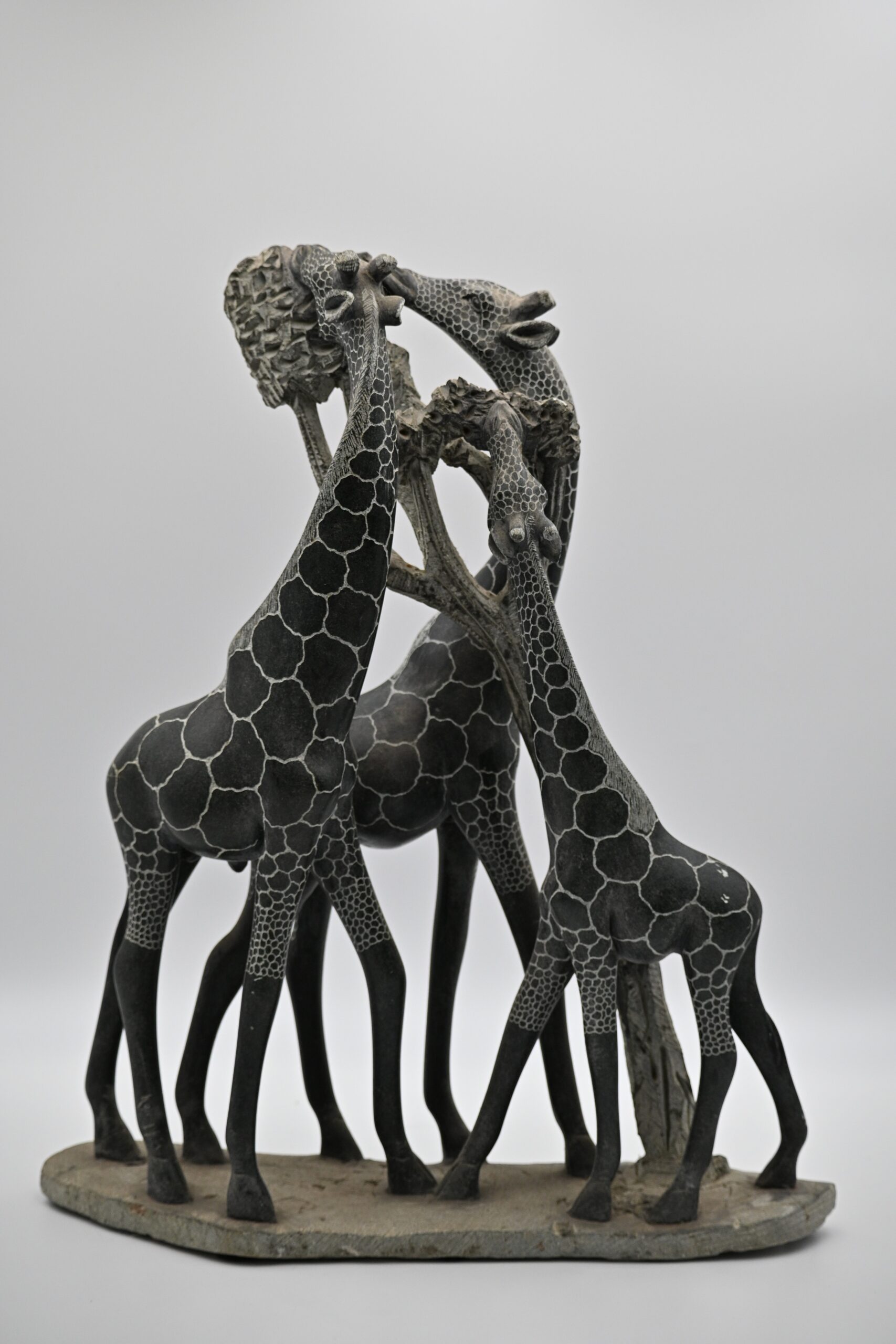
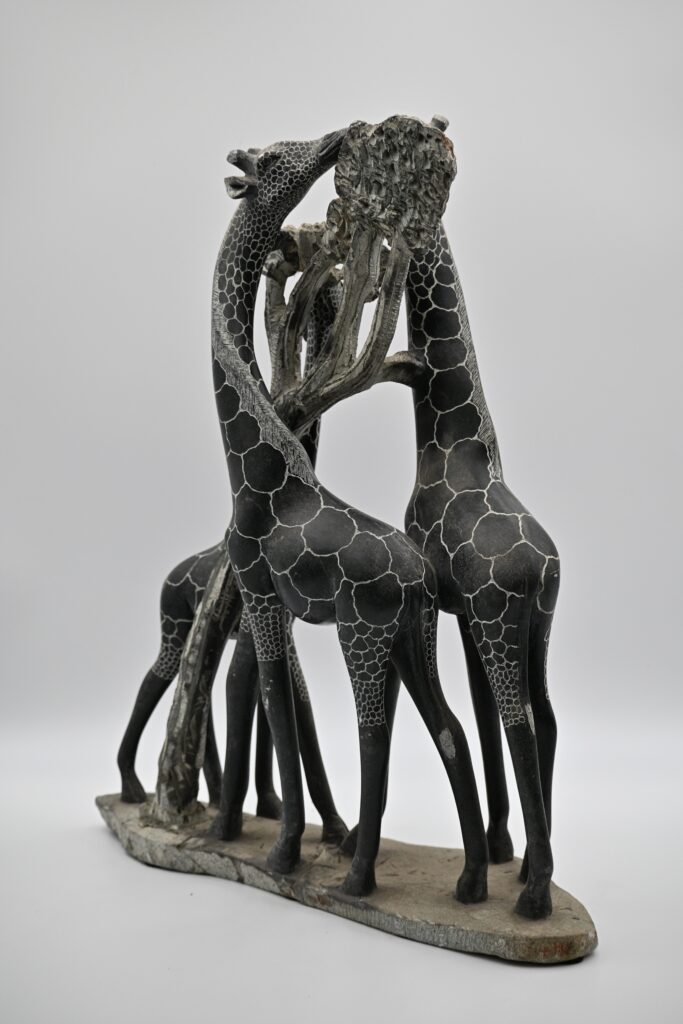
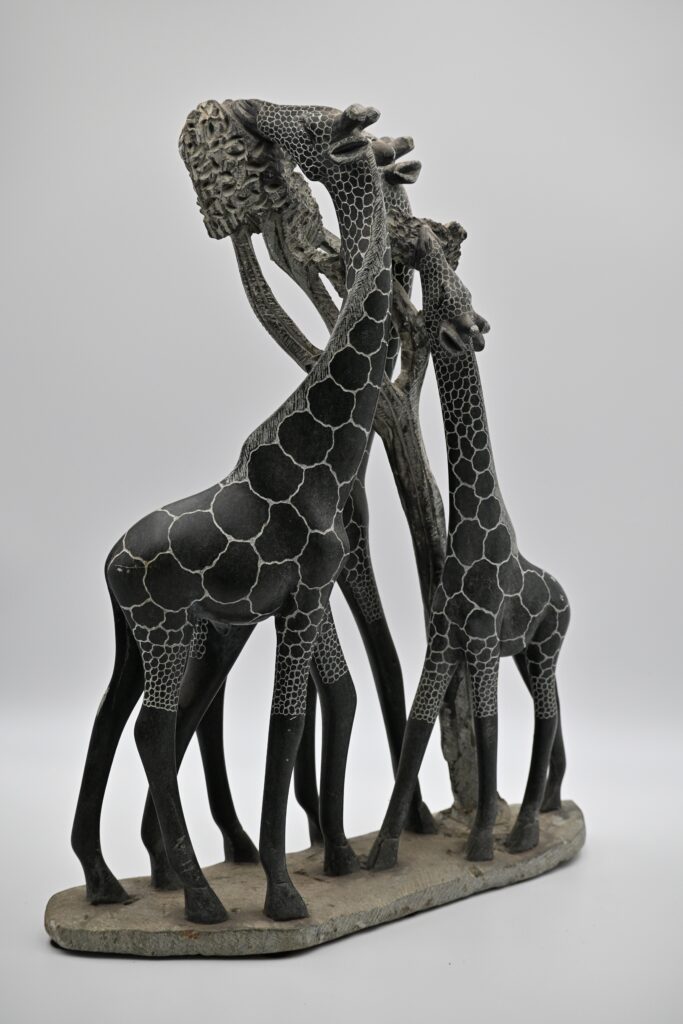
Walk slowly around this sculpture and at some point the stone stops behaving like stone. Long necks cross and recross, a head tips back into a crown of leaves, a smaller animal stretches up among its elders, and the whole group seems to sway the way giraffes do when they feed high in the branches. Then you reach the far side and see the trunks threading between the bodies, the legs cut free into slender columns, everything standing on one integral oval base.
This is Lot 4021, catalogued as a large Shona carved serpentine sculpture of four giraffes among acacia trees. It comes out of one of the great twentieth-century chapters in African art, and it tells that story with an unusually light, lyrical touch.
From Great Zimbabwe to a Gallery Basement
Stone has a long memory in Zimbabwe. Great Zimbabwe, the walled town that flourished from about 1250 to 1450, was built of local granite laid without mortar, and its ruins still speak of a deep fluency in working stone. Yet the figurative sculpture the world now calls Shona is a modern art, one that took shape in the 1950s and 1960s in what was then Southern Rhodesia.
A pivotal figure was Frank McEwen, appointed in 1956 to direct the new Rhodes National Gallery, which opened in Salisbury, today Harare, on 16 July 1957. An informal workshop grew up in the museum's basement, and within a year carving had overtaken painting and drawing as its heart. The movement took its popular name from the Shona, the most numerous people in Zimbabwe.
In 1966 a second centre emerged. Tom Blomefield, a tobacco farmer and chrome miner whose trades had been hit by sanctions, opened his land at Tengenenge to working sculptors. The name is rendered as "the beginning of the beginning," and the community became one of the anchors of the whole movement. In 1971 the Musée Rodin in Paris mounted an exhibition of Shona sculpture, London's ICA followed in 1972, and through that decade shows in Paris, London and New York carried the work to an international public.
The Stone of the Great Dyke
Much of the stone these carvers use comes from the Great Dyke, an immense horseshoe-shaped geological formation that runs from the centre of Zimbabwe toward the north and east. Tengenenge sits right against it, and in that village almost everyone, man or woman, carves serpentine and springstone dug nearby. Serpentine is a wonderfully varied material, found in more than two hundred colour variations, and its hardest, darkest form is black. The listing describes this lot simply as black serpentine, the deep end of that spectrum, and names no quarry or community for it; and it takes a polish like still water at night.
The early masters spoke about the stone almost as a collaborator, letting the shape of each block guide the form it would take. Watching how this giraffe group bends around its trees, one feels that same conversation between hand and material.
Reading the Carving
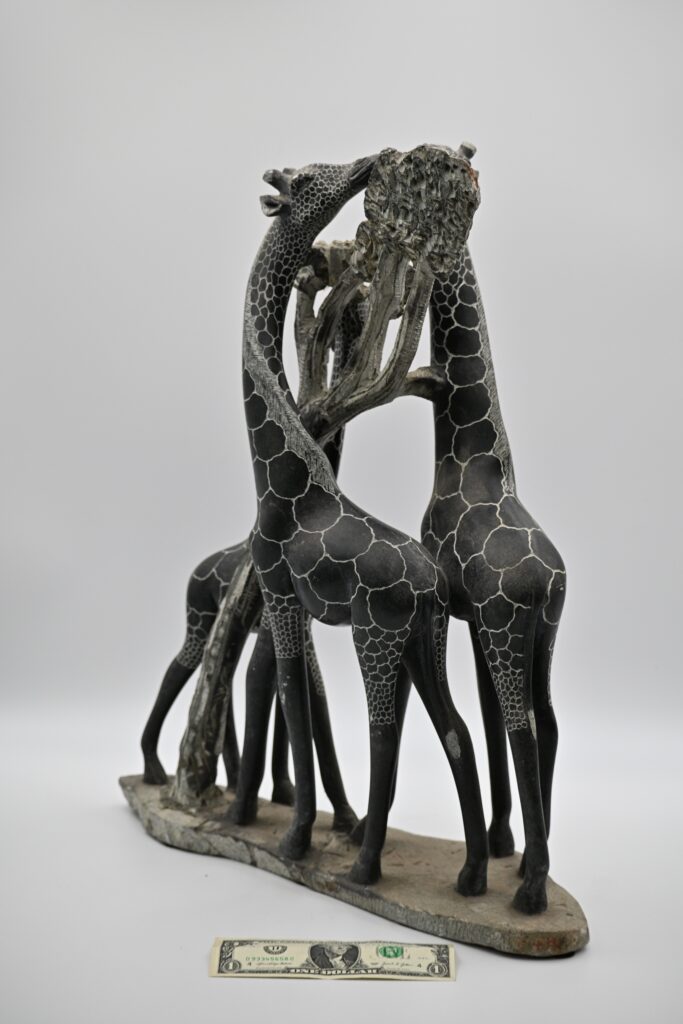
The carver chose a demanding subject and met it with confidence. The listing describes four giraffes of varying sizes browsing among stylized acacias, and the composition is built on height and air. Legs descend as slim columns ending in small, neat hooves. Necks rise in long arcs. Heads, crowned with little horns and with mouths open, reach into the foliage, while one smaller animal stands among the adults, its face turned up toward the canopy. From every angle the group knots and unknots into a new arrangement of crossing lines.
The surface is where the work becomes truly memorable. Over the polished black bodies runs a net of pale carved lines that builds the reticulated coat: broad, irregular patches across flanks and shoulders, tightening into small, close cells along the necks and down the legs. The manes are worked in fine hatching. Against that dark sheen, the acacias are left lighter and rougher, with textured trunks and crowns of foliage carved into a dense, crusted mass, and the base is left as grey, rugged ground. Sleek animals, rough bark, open earth: the contrast of surfaces does real narrative work.
In the first photograph a dollar bill laid before the base gives a sense of scale, and the herd rises far above it. No signature appears in the photographs, and the listing names no sculptor; the piece speaks through its craft alone.
Why Collectors Gather Shona Stone
Shona carvers have long given animals a place beside their human and spiritual subjects, from serpentine elephants to warthogs and snails, and a multi-figure animal group on this scale is a different undertaking from a single creature. Every open space between leg and trunk had to be cut away; every slender element had to be carried through to the end of the work.
Family is a recurring theme in Shona sculpture, and Shona thought holds that all creatures are children of the earth, expressed in the phrase mwana vevhu, son or daughter of the soil. It is hard not to see something of that idea in this herd, with its smaller animal gathered among the larger ones, all feeding together beneath the same trees. For a collector, that is the lasting pleasure here: a sculpture that rewards a full walk around it, holds its own in a room, and carries the story of a remarkable movement in polished black stone.
Lot 4021 will be offered in the Lionheart Auction sale on Saturday, November 28, 2026 at 4:00 PM ET, with bidding on Proxibid. If this quiet herd of black serpentine giraffes has caught your eye, we warmly invite you to study the photographs at leisure and place your bid on Lot 4021 when the sale opens.