The Moment Before the Leap
Anyone who has climbed the ladder at a public pool knows the feeling. From the ground the tower looked modest. At the top, the board seems to run on forever, the railing ends sooner than it should, and the sky takes up far more of the world than it did a minute ago. Norman Rockwell distilled that private reckoning into a single image, and he did it without showing a drop of water.
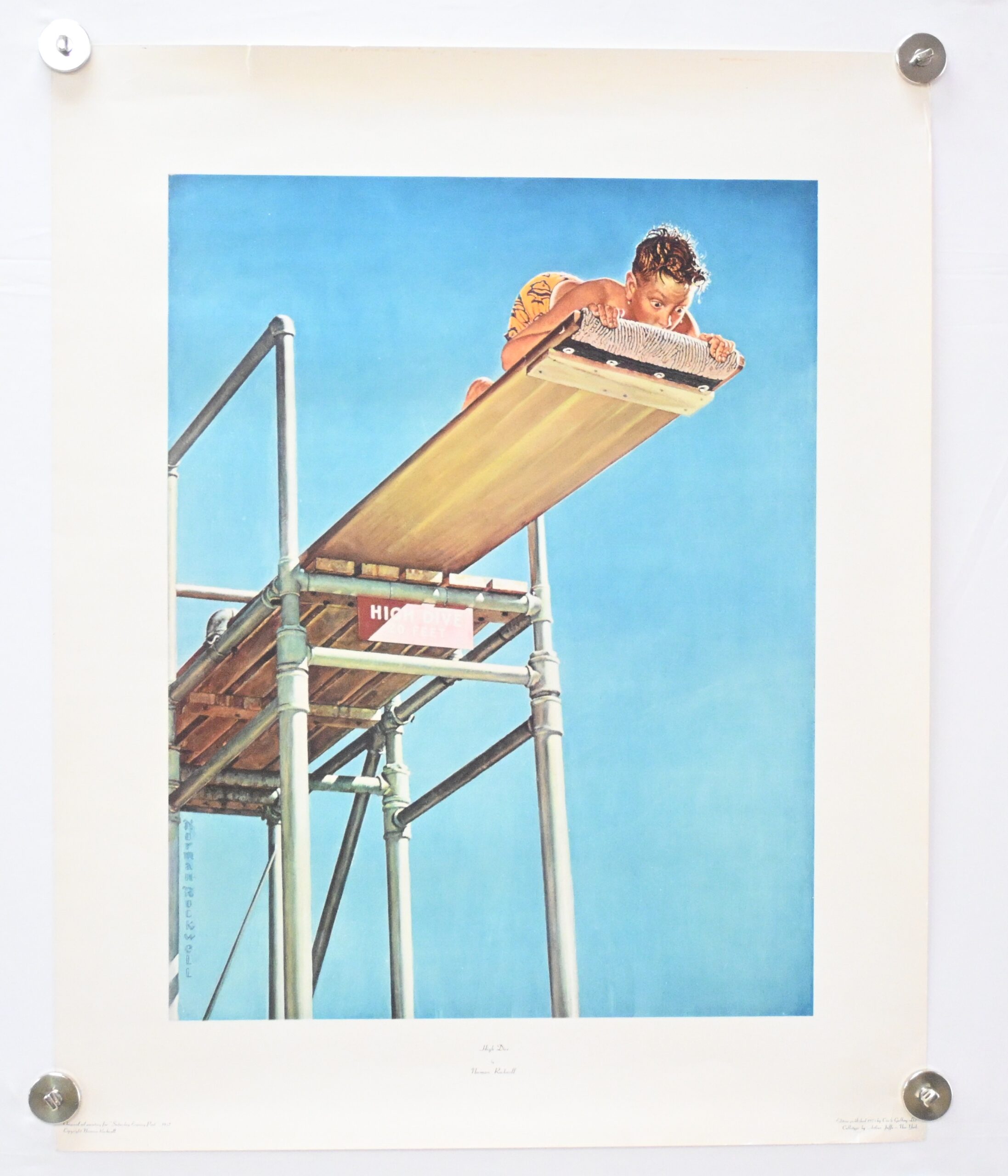
In High Dive we stand beneath the tower and look up. The board shoots diagonally across the composition like a ramp launched into open air, carried on a frame of pipe scaffolding. At its far end a boy lies flat, both hands clamped over the textured lip, his hair lit by the sun and his eyes stretched wide at whatever waits below. A small red sign bolted to the frame announces HIGH DIVE, as though he needed the reminder. Everything we need to know is in that face, and everything we fear is out of frame.
A Cover for August 1947
Rockwell, the American realist who lived from 1894 to 1978, painted the scene for the cover of the Saturday Evening Post issue of August 16, 1947. It is a late-summer picture in the best sense: bright, open and lightly comic, yet built around a feeling every reader had carried at some point, the moment when bravado runs out and the decision still has to be made.
The model came from close to home. According to the Norman Rockwell Museum, the boy is the artist's youngest son, Peter. To catch real alarm rather than a posed version of it, Rockwell carried his easel out to the balcony of his studio, cranked it up as far as it would go, and set Peter on a plank hanging out over the two-story space below. The fright on that face, in other words, was not entirely acted.
It is a lovely studio story, and it says a great deal about how much effort Rockwell would spend on a single expression. The painting succeeds because the theatre is honest. The boy is not posing for us; he is busy being terrified, and we are let in on it.
Arthur Jaffe and the Collotype
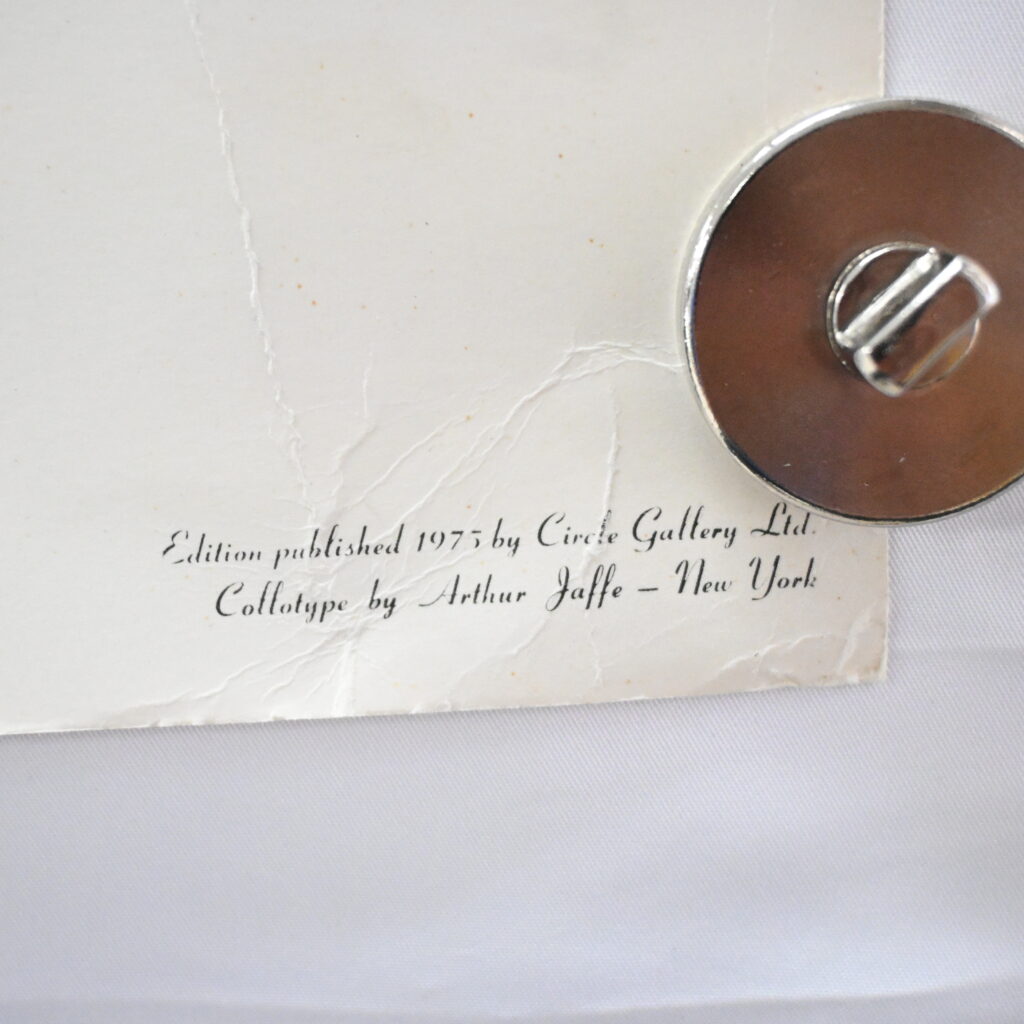
Nearly three decades after the cover appeared, the image found a second life in print. The sheet offered here is a collotype, and its lower margin states its terms plainly: the edition was published in 1975 by Circle Gallery Ltd., with the collotype by Arthur Jaffe of New York.
Collotype was once the leading process for reproducing fine art, valued for the extraordinary detail it could hold, and it drifted into obscurity largely because doing it well was so costly. During the 1970s Circle Gallery issued a run of Rockwell subjects in the medium, among them Freedom of Speech, Freedom of Worship, Shuffleton's Barber Shop and The Discovery, with plates by the master printer Arthur Jaffe in New York, and some later titles printed by Max Jaffe in Vienna. Rockwell worked with Circle Gallery on these projects, which is part of why the publisher's name carries weight with collectors of his printed work today.
Reading the Sheet
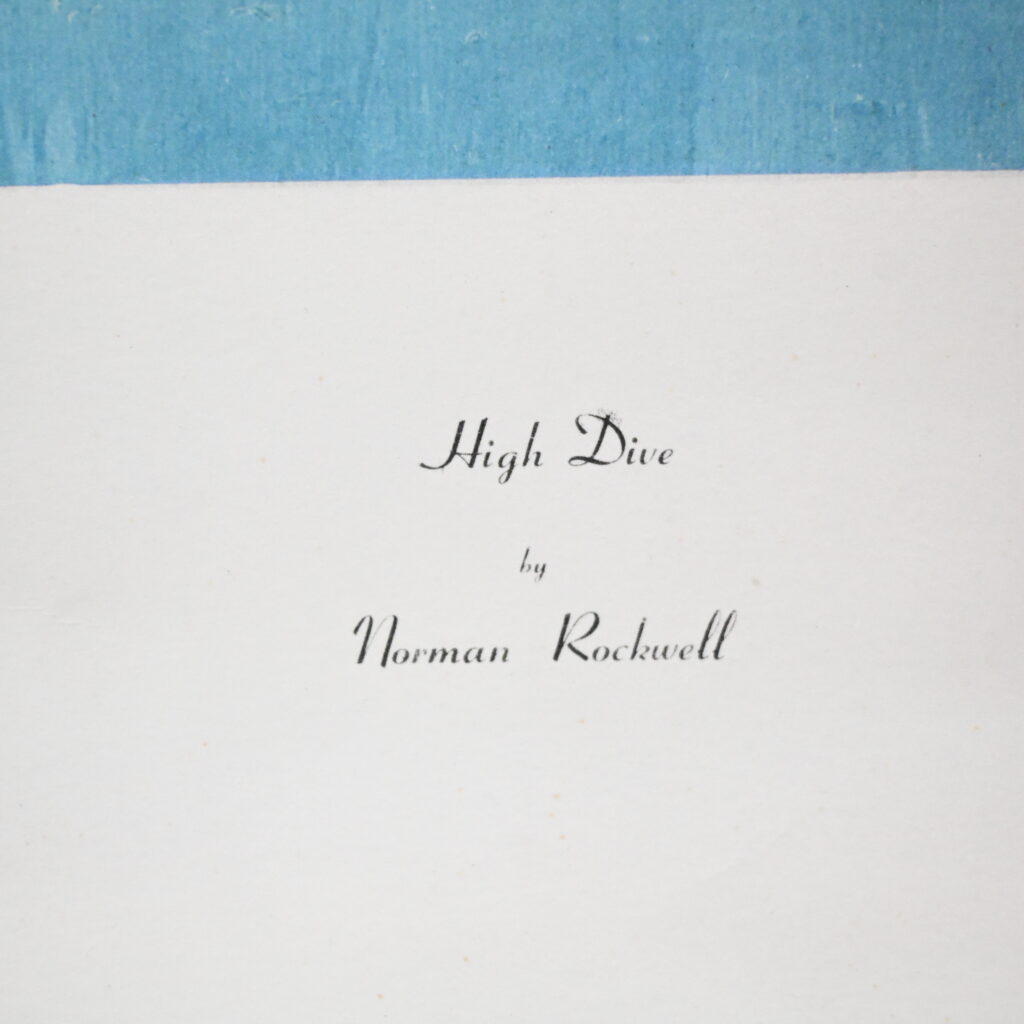
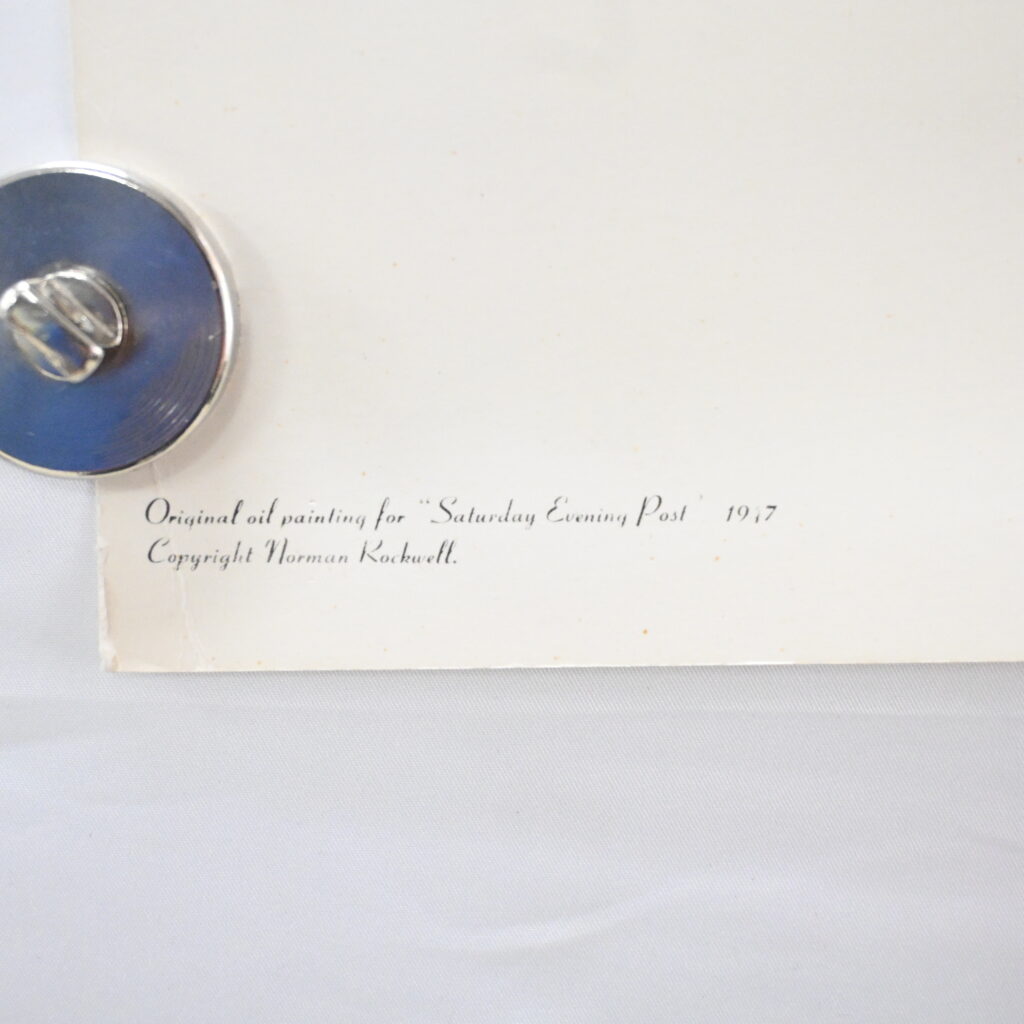
The marks on this example repay a slow reading. Centered beneath the image, in a graceful printed script, are the words High Dive by Norman Rockwell. At lower left the margin records the source: Original oil painting for "Saturday Evening Post" 1947, Copyright Norman Rockwell. At lower right sits the colophon naming Circle Gallery Ltd., the 1975 publication date and Arthur Jaffe's New York collotype. Within the picture itself, the painter's name, reproduced from the canvas, climbs vertically up the left-hand post of the scaffold.
To be precise about what this is: a 1975 collotype after Rockwell's 1947 oil painting, not the painting itself. The canvas is the source; this sheet is its carefully made printed descendant. It measures approximately 22 by 30 inches, a generous scale that gives the composition room to breathe, with broad white margins framing the image.
The full-color reproduction rewards close looking. The sky is a deep, saturated blue from edge to edge. The board glows warm against it, its underside falling into shadow. The boy's patterned yellow trunks, the rough mat under his fingers and the pale gray pipe fittings of the tower are all rendered with the crisp clarity that made the process prized.
Why Collectors Climb the Ladder
Rockwell's best covers last because they need no caption, and High Dive may be the purest example. There is no joke to explain and no period detail to decode, only a child, a board and a long way down. That makes it as readable to a ten-year-old today as it was to a Post subscriber in 1947.
For collectors of American illustration, the subject is among the most memorable of Rockwell's summer images. For those who love printing, the Jaffe collotypes represent a demanding craft that has largely disappeared. This sheet answers both appetites at once. Framed, it reads from across a room, and it would feel entirely at home in a pool house, a beach cottage or a study where someone still remembers that first climb.
High Dive is a picture about the instant before you commit, and here is a happier version of that moment. This 1975 Circle Gallery collotype, printed by Arthur Jaffe in New York after Rockwell's 1947 Saturday Evening Post cover, is offered as Lot 4174 in the Lionheart Auction sale on Proxibid. Climb the ladder with us and place your bid on Saturday, November 28, 2026, at 4:00 PM ET.