
Two Times at Once
There is a particular romance to a watch that keeps two clocks at once. It belongs to the era when jet travel first folded oceans into a single long afternoon, when a captain over the Atlantic needed to know the hour at home, the hour at the destination and the hour by which the whole world set its watches. Rolex answered that need with one extra hand and a turning ring of color, and in doing so drew one of the most recognizable faces in twentieth-century design.
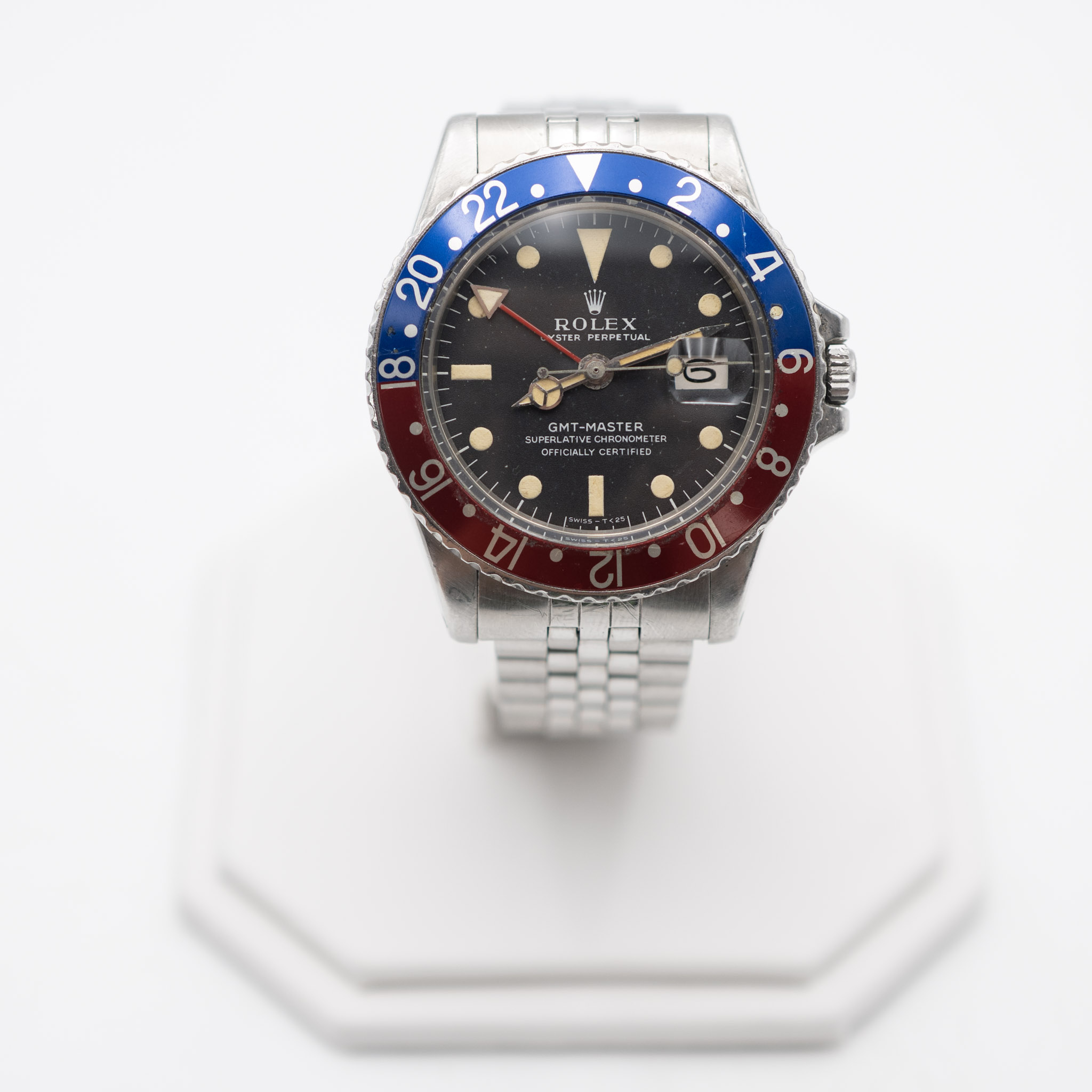
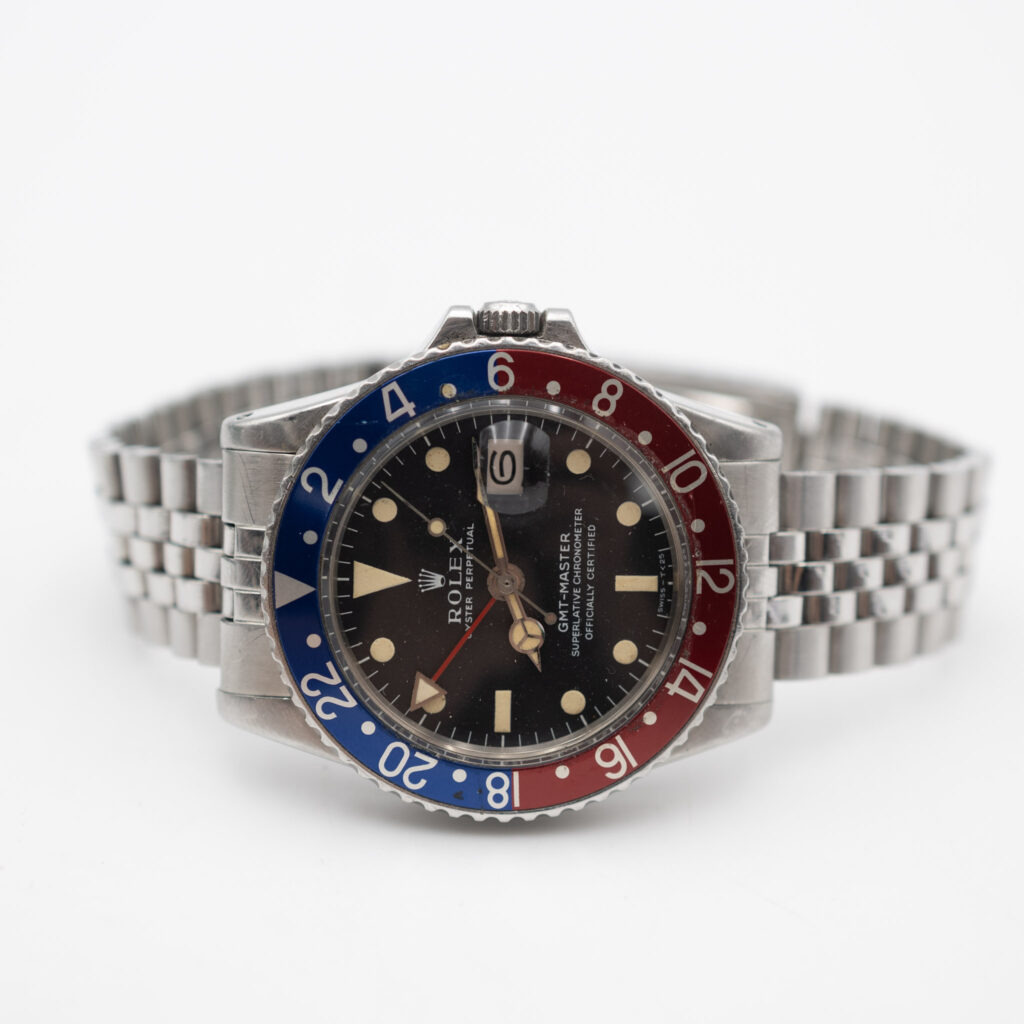
Lot 4026 in our coming sale is a stainless steel Rolex Oyster Perpetual GMT-Master, reference 1675, offered as a 1971 example. Its bezel is split between blue and red, its black dial is lit with luminous markers, and it rides on a steel Jubilee bracelet. It is, in short, the GMT-Master as most of us picture it when we close our eyes.
Built for the Long-Haul Crews
The story begins with Pan American World Airways. The airline asked Rolex for a dependable watch that could show more than one time zone at a glance for crews flying transatlantic routes, and the answer was the reference 6542, introduced in 1954 with commercial production following in 1955. Its central idea was elegantly simple: a 24-hour hand geared to the ordinary hour hand. Set that hand to Greenwich Mean Time, then rotate the 24-hour bezel to the offset you need, and a second time zone is read straight off the ring.
That first model measured 38mm in an Oyster Perpetual case, and its bidirectional bezel was made of Bakelite, an early plastic, with luminous numerals for the 24-hour scale. Even then it was half red and half blue, a day and night code that let the wearer tell daylight hours from darkness without a second thought.
The Reference 1675 Takes the Controls
Bakelite turned out to be too brittle for a working instrument, so when Rolex introduced the successor, reference 1675, in 1959, it fitted a tougher aluminum bezel insert. The new watch also gained crown guards, the protective shoulders flanking the winding crown, and the case grew to 40mm to accommodate them. Specialists often describe the 1675 as the first GMT-Master designed from the ground up as a dual-time watch, and many of its traits still define the GMT-Master II that Rolex makes today.
The 1675 then enjoyed a run of more than two decades. Over that long life Rolex refined its dials, movements, handsets, bezel colors and bracelets, which is why the reference rewards close study. According to one specialist history, the model was also issued to United States Air Force test pilots and to NASA astronauts, a fitting record for a watch conceived in the cockpit.
Reading the Dial
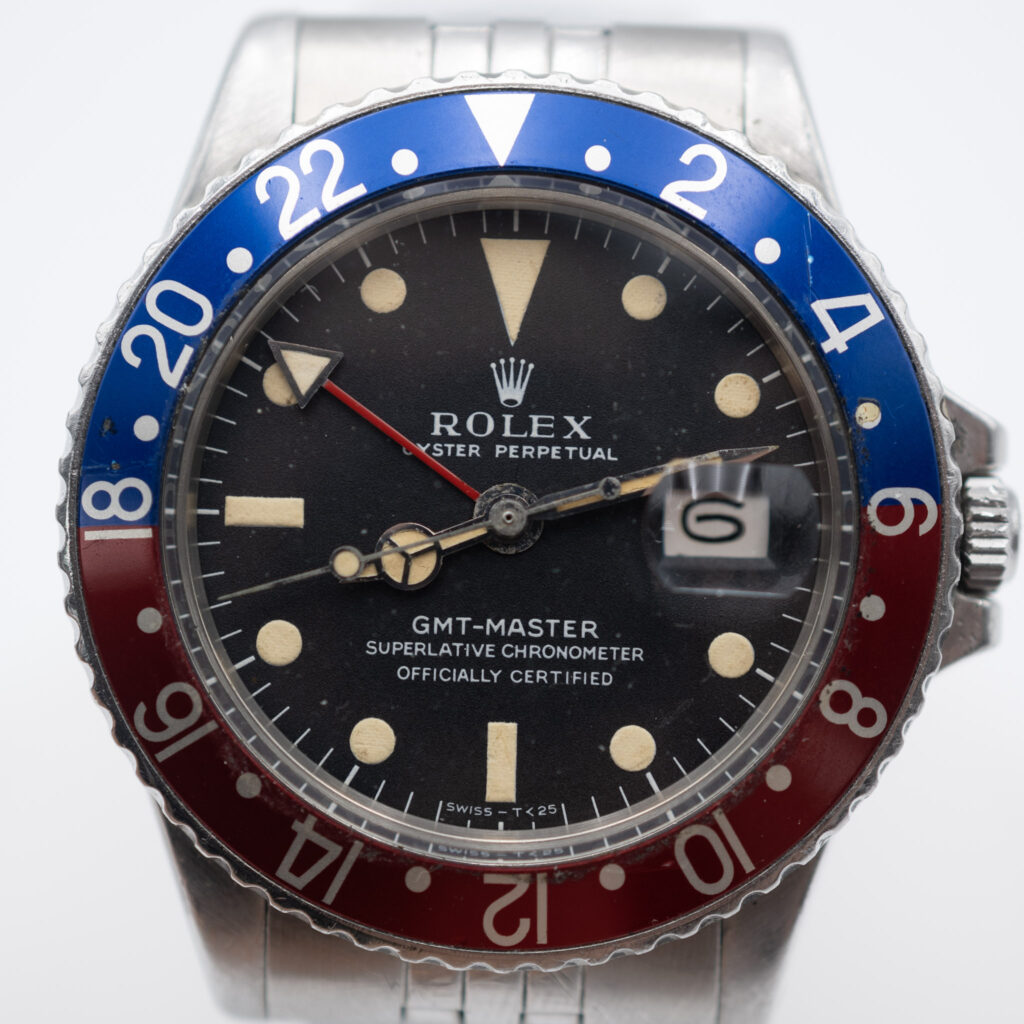
Everything that matters on this watch is written in plain sight. Beneath the coronet the black dial reads ROLEX and OYSTER PERPETUAL, and below center it announces GMT-MASTER above the two lines SUPERLATIVE CHRONOMETER and OFFICIALLY CERTIFIED. The hour track is laid out in luminous dots and batons, with an inverted triangle at twelve, while the hour hand carries the circular Mercedes motif. The slim red GMT hand ends in a luminous triangle that sweeps the bezel once a day, and at three o'clock a date window sits beneath the cyclops magnifier.
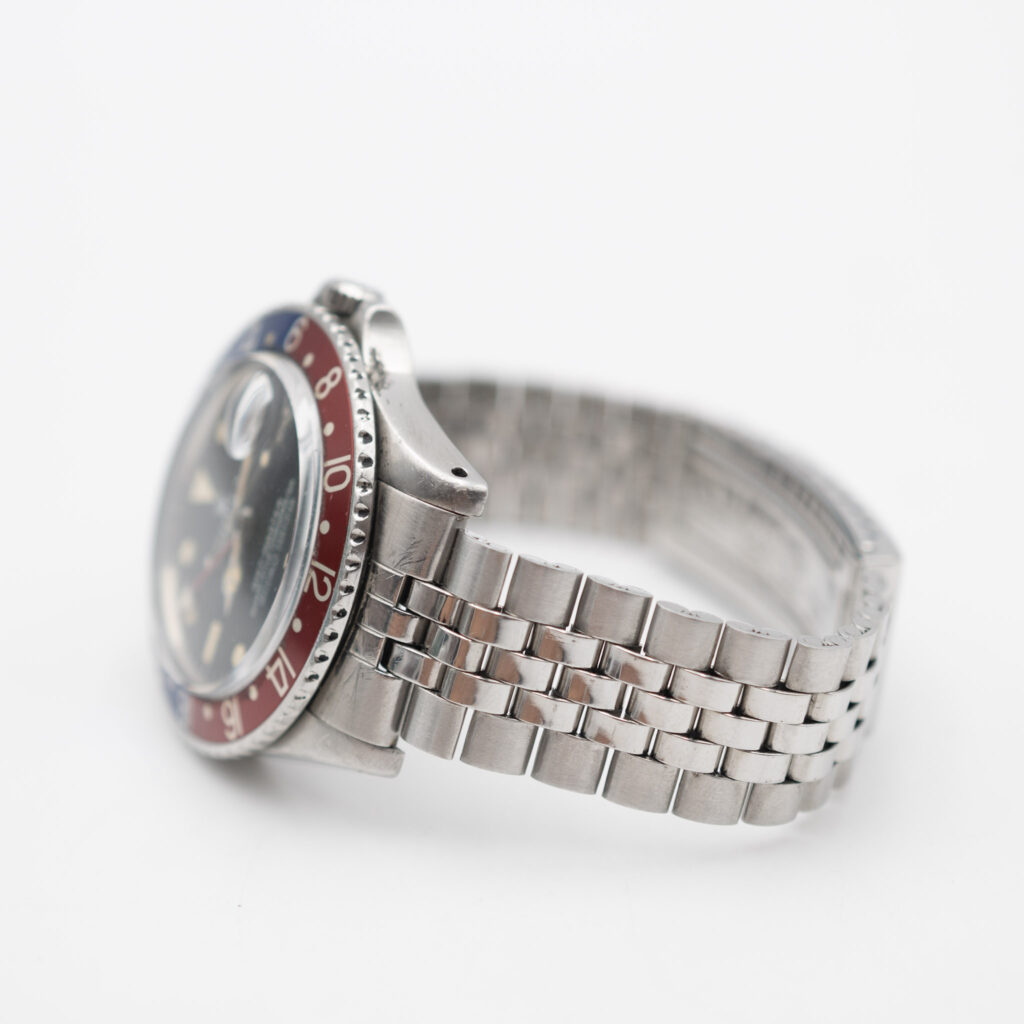
The bezel itself is a small masterpiece of graphic economy: a triangle at the 24 position, even hours in bold numerals and dots marking the odd ones, blue running across the night hours from 18 through 6 and red across the daylight hours from 6 through 18. On the case flank, the screw-down crown sits snugly between its guards, exactly the arrangement that set the 1675 apart from its predecessor. Lionheart's specialists have examined and authenticated this watch.
The Fine Print and the Bracelet
Look closely at six o'clock and you will find the tiny inscription SWISS – T<25. That marking signals a Swiss watch whose tritium luminous material emits less than 25 millicuries. Swiss rules have required a T designation on tritium dials since 1964, and the T<25 form tends to appear on sports models, which carry far more luminous material than dress watches thanks to their generous markers and hands. For collectors it is a small line of text that places a dial firmly in its era.
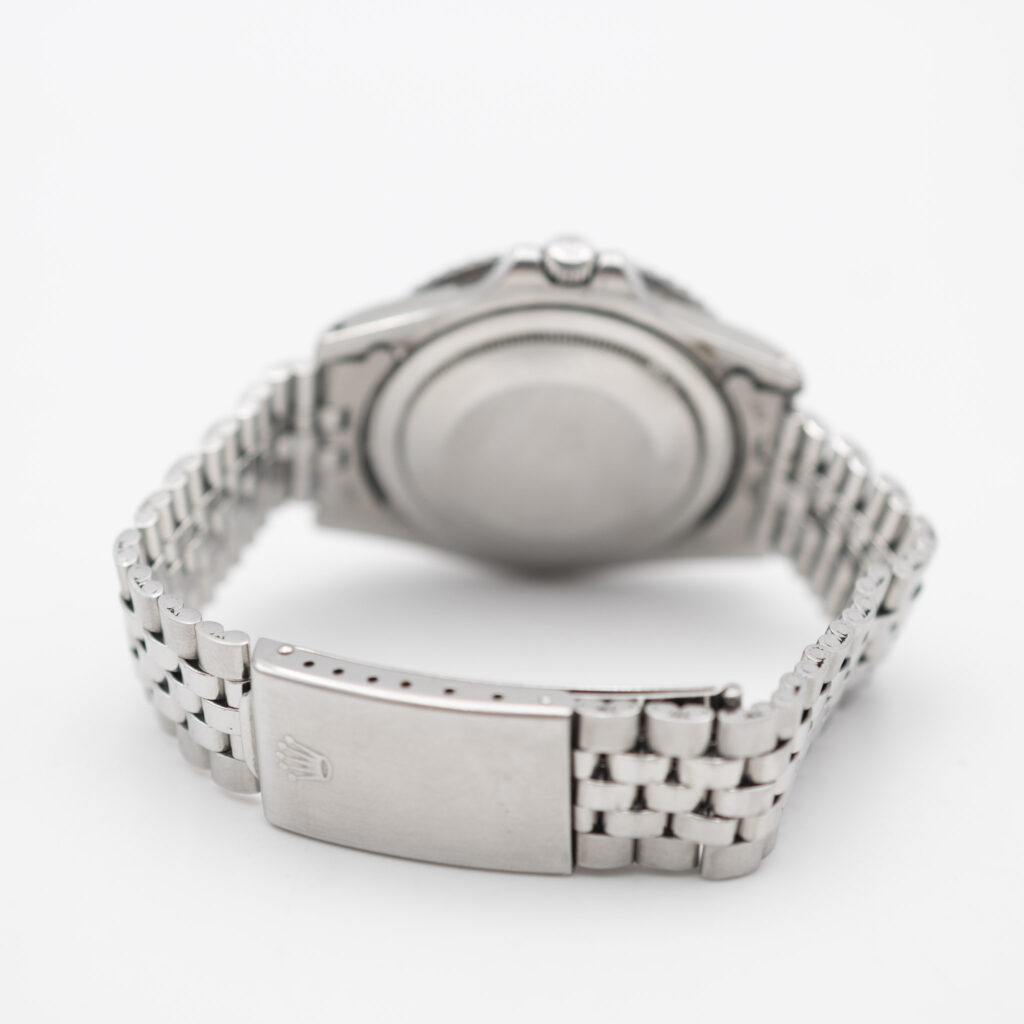
The bracelet is a Jubilee, the five-piece design of two broad satin-finished outer links flanking three smaller polished links. Rolex created it in 1945 for the launch of the Datejust, marking the firm's fortieth anniversary. Here its folding clasp is stamped with the Rolex crown. On a tool watch built for pilots, the Jubilee lends a softer, dressier shimmer that suits city streets as easily as airport lounges.
Why the 1675 Endures
Among vintage Rolex sports watches, the reference 1675 holds a special place. Its long production makes it easier to find than many vintage Rolex references, and it is often called the gateway into vintage Rolex sports watch collecting. Yet familiarity has never dulled its appeal. The 1675 sits at the hinge of the GMT-Master story, carrying the original 1950s idea forward into the form the world still recognizes, and the many small variations across its run give the serious collector a lifetime of things to compare and admire.
Above all, it is the color that lingers. That blue and red ring, conceived as a practical code for day and night, became the iconic combination collectors simply call the Pepsi bezel. To wear an example from the reference that made it famous is to wear a piece of the source.
Lot 4026, a Rolex GMT-Master reference 1675 offered as a 1971 example, with its blue and red bezel, black dial and Jubilee bracelet, crosses the block in the Lionheart Auction sale on Saturday, November 28, 2026, at 4:00 PM ET, with bidding on Proxibid. If a watch that keeps two worlds in view has ever caught your eye, this is your moment to place a bid and bring it home.